Showing posts sorted by relevance for query napier. Sort by date Show all posts

Thursday, June 26, 2025

St. Mary's Napier, Oldest Church in Middlesex

Normally, if you want to see the pioneer buildings constructed by our ancestors, you have to visit a museum like Fanshawe Pioneer Village. That's because most of our early buildings were torn down and replaced with larger, grander ones as soon as it was practical to do so. If not demolished, the earliest buildings were usually modernized to include electricity, plumbing, openable windows, and insulation. Nobody likes privations. 

That's why it's fascinating to enter one of those rare pioneer structures that's almost completely unchanged. I'm talking about St. Mary's, Napier.

St. Mary's Anglican Church, Napier, southwest of Strathroy in the Township of Adelaide-Metcalfe, held its Annual Decoration Day service on Sunday, June 22, 2025. Fred Cahill, who lives down the road, rode his horse, Beauty, to the event. She was a reminder of those long-ago days when most of the congregation arrived by horse and buggy. 

This unassuming little frame building was built in about 1841 in the village of Napier in what was, in those days, Metcalfe Township.  Centre of a thriving community founded by retired veterans of the British Army and Navy, the church remained open for weekly services until about 1920.  Then, with a dwindling congregation, the church closed. Instead of being demolished, though, it became a Chapel of Ease, still used for occasional services like the one I attended with about 30 other people (and Beauty, the horse) last Sunday.

No, my ancestors didn't live nearby, they didn't worship here, and I don't have relatives buried in the adjoining graveyard. So why attend? Because St. Mary's is now the oldest remaining church in Middlesex County and a treat for history buffs.


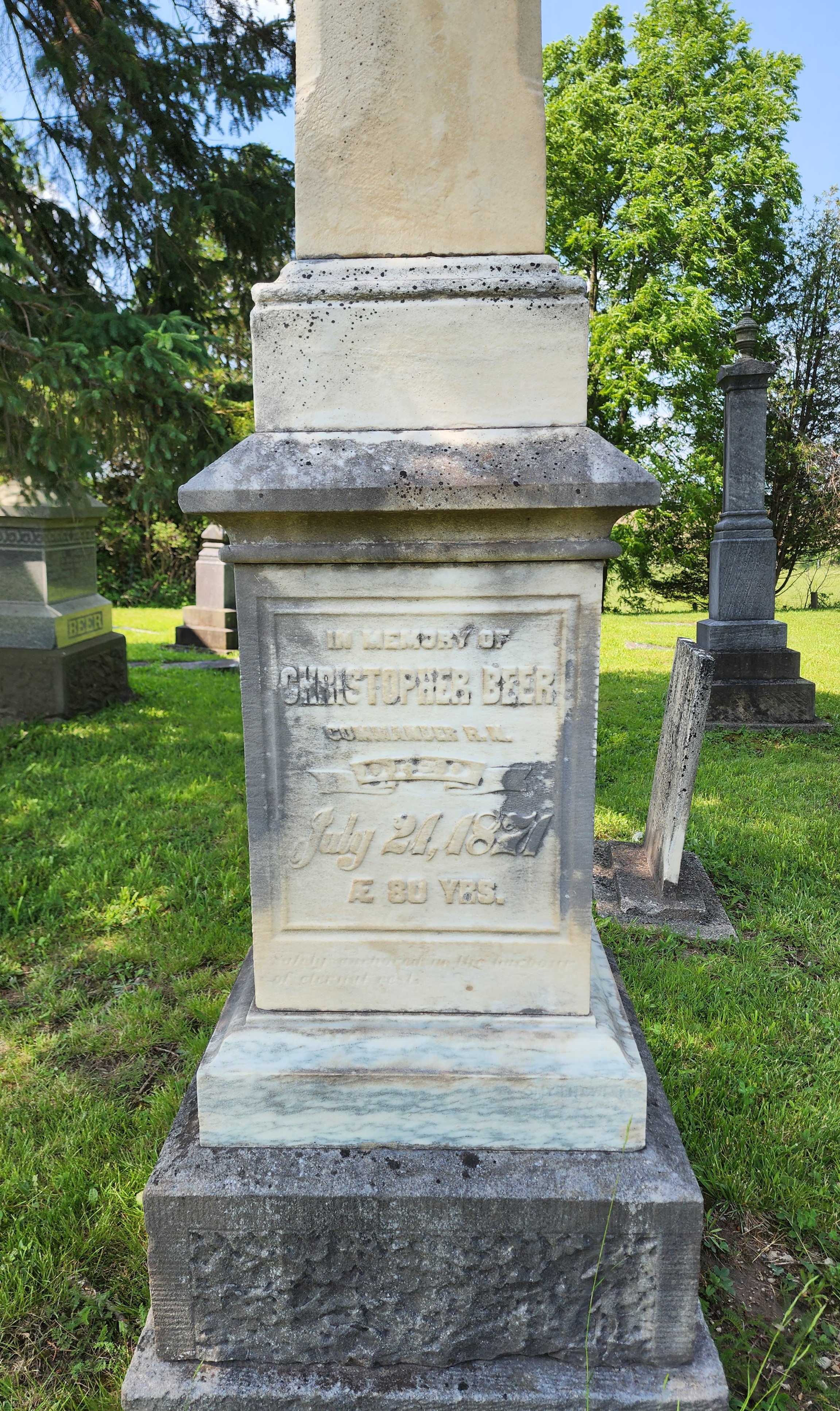
The story inside the service booklet states that early settler Captain Christopher Beer (gravemarker at right) was about to build himself a new house out of the local black walnut. But when he heard a church was to be constructed, he put off the building of his own home and donated the lumber to the church project instead. The walnut was used to build the chancel, pulpit, pews, and wainscotting. It's still in there today, dark and handsome as ever. 

There was more to the building project than Captain Beer, of course. The land for the church and cemetery was donated by Lieutenant Charles Preston. The Phillips family donated the oak stringers and some bricks came from Captain Johnson's brickyard. That was how a pioneer community worked; everyone pitched in what they had, whether it was time, labour, materials, or funding. 

At one time, services were so popular that a gallery was installed to accommodate everyone. But by 1895, the  gallery was deemed unsafe and the congregation was too small by then to warrant it anyway. It was removed. 

Let's step inside and see what it's like today:

"Box pews" with doors, designed to provide warmth and privacy. Such doors were common before churches were heated, allowing seating areas to retain warmth, either from bodies sitting close together or from foot warmers. When pews were owned or rented, such doors helped ensure that everyone sat in the correct place. 


Fresh flowers for the Decoration Day service. Note the walnut pulpit.

Storage.

View from the pulpit.

Pump organ added in the 1900s has not worked for 20 years. (I heard a rumour about mice.)

Close-up of the foot pedals reading "Doherty Organ." For a history of Doherty, see here.

I wonder who was small enough to sit on the back row pews? Were Victorian bums this much smaller than ours? Or did children sit here? 

Photos and documents hang on the wall. Here's a photo of those in attendance on June 30, 1963 when the blue plaque from the Archaeological and Historic Sites Board of Ontario was placed out front. One of the gents is a great-grandson of Captain Beer. 

By the way, while sitting through the half hour service presided over by Rev. Patty Dobbs Luxton of Strathroy, I became aware of the extent to which our pioneer ancestors were at the mercy of the elements. It was over 30 degrees on Sunday and this little building has only one door, early unopenable windows, and no electricity. So no air conditioning and not even a cross breeze. The heat you can't imagine. Every time I stood up, my dress stuck to the rear of the pew. Just imagine sitting there in long sleeves, multiple petticoats and a bonnet. Egad. 

Next, think about winter. No electric heat. No insulation of the modern variety. (Could there be horse hair in those walls?) No storm windows. And I'm not sure if there was ever a wood stove. The congregation might have seen the officiant's breath in the air. Huddle with your neighbours to keep warm. 

Back outside, I trotted around the graveyard. Since I first visited St. Mary's back in the 1990s, the stones have greatly deteriorated. Aside from the monument to Captain Beer (now "Anchored in the harbour of eternal rest") the others are mainly illegible:


Some TLC is obviously needed. But I'm sure that diocese funds are woefully inadequate. What's required is a fundraising organization. Would someone like to start "The Friends of St. Mary's, Napier?" I'll join.

You may be wondering why this little church closed. That's easy. It's in a ghost town. Napier, on the Sydenham River, was once one of the most important villages in west Middlesex. It was a milling village, built to take advantage of the walnut trees in the vicinity. Once the walnut trees were depleted, there was obviously less work for the sawmills.

But in 1857, according to Lovell's Canada Directory, Napier also had a gristmill, woollen mill, school, store, blacksmith, shoemaker, waggon maker, saloon, and many homes. By 1864, there were two hotels, the Napier Inn and the Sydenham House, and a population of about 250. A post office named Napier opened on November 6, 1851, under postmaster James Keefer, who was running a store with Captain John Arthur. Mail came by stagecoach. 

In all probability, Napier faded after being bypassed by the railroads. Both branches of the Great Western Railway, later the Grand Trunk or CNR, were built elsewhere, the north branch through Kerwood and the southern through Glencoe. Later the village was bypassed by the CPR and the Michigan Central. The community just couldn't win. The post office closed in 1915. 

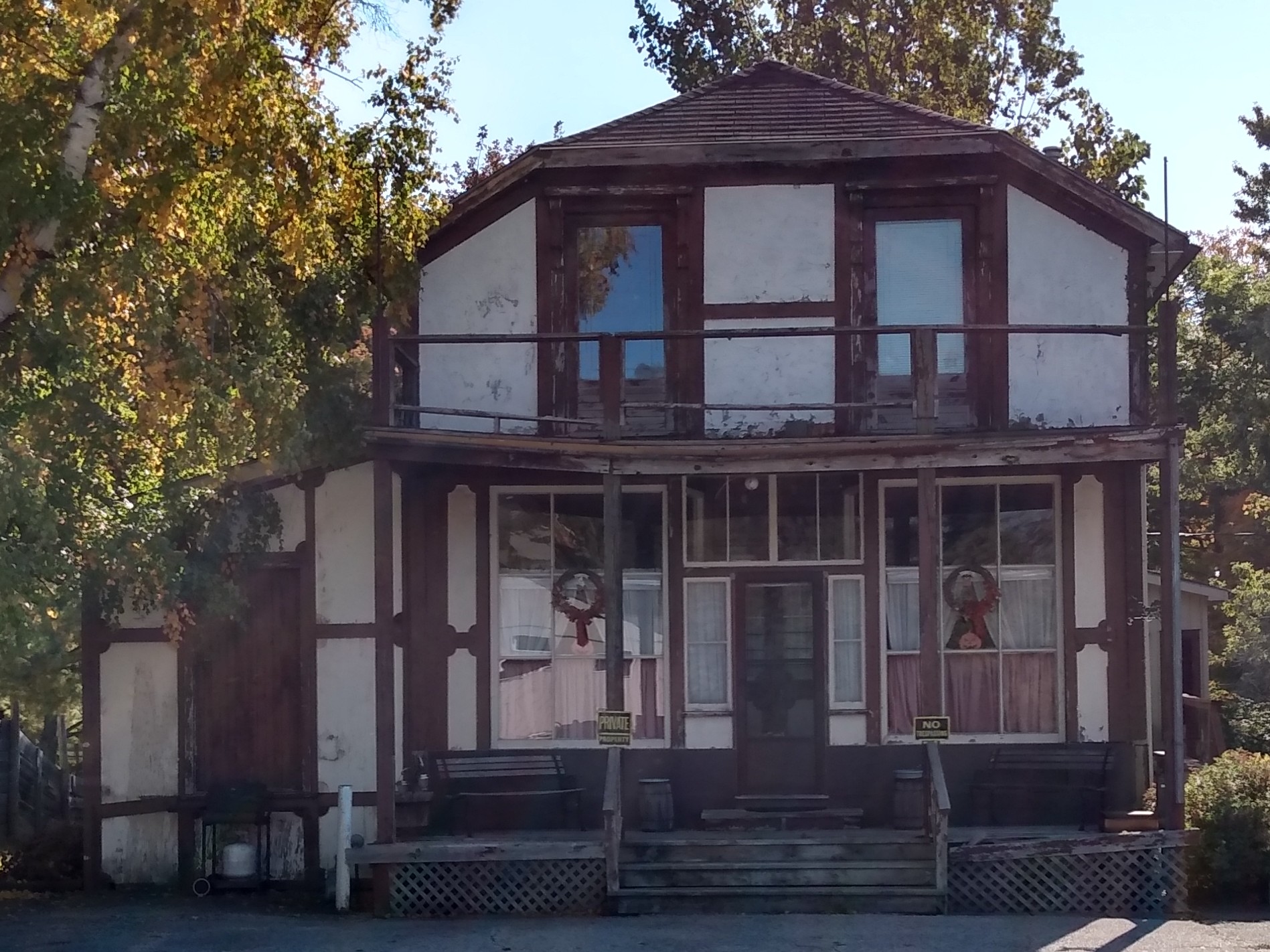
Recently there was an attempt to restore one of Napier's old buildings, the 1872 Napier House store. The effort failed and it now looks like this: 


Apparently a saviour is needed here too. 

A greater puzzle, as far as I'm concerned, is why St. Marys was preserved after closing. In 1939, it was in poor repair, turrets fallen off the tower, windows broken, and the graveyard thick with weeds. It was restored, when and by whom I'm not sure. But with no regular congregation, there was no need for updates. It seems that enough people cared about St. Mary's to preserve it, even if it remained a primitive pioneer structure.  

I hope it remains for many years to come. 


Monday, September 15, 2014

Doors Open Middlesex 2014

St. Andrew's Presbyterian, Napier
In 2014, Doors Open London and Doors Open Middlesex fall on different weekends, allowing adventurous Londoners to explore the wilds of Middlesex County and still view London attractions later in the month. Being restricted to one day of sight-seeing only, I couldn't even fit all the Middlesex locations into my schedule. But the fact that the locations were restricted to the western part of the county, mostly in the Strathroy area, made getting about a little easier.

I chose to drive all the way out to Napier and work my way back towards London. Napier is an idyllic "ghost town," filled with hustle and bustle in the nineteenth century but now a quiet reminder of the Ontario of yesteryear. In an out-of-the-way location on unpaved Napier Road, St. Andrew's Presbyterian Church and surrounding hamlet might be a little hard to find, perhaps explaining why I was the only visitor at the church when I arrived about 1:00. It's disconcerting when there are more volunteers than guests so I hope there were other callers at this quaint 1887 brick building. The inside is plain and simple, not surprising for a structure built by a late-1800s rural congregation, and the sense of peace and calm is palpable. Not that St. Andrew's is a closed church; a small congregation of about 30 is using it for Sunday services. The congregation was founded in 1863 in an earlier church building, making last year a 150th anniversary.

Making my way back to Strathroy, I stopped at the former Strathroy Flour Mills on Albert Street, now home to the Strathroy Brewing Co. I was a little late to join a large tour, so contented myself with a generous sample of 1812 Independence Pale Ale, named to commemorate the fighting spirit that maintained Canada's independence from the United States during the War of 1812. There were considerably more visitors at the brewery than at my first stop, suggesting either that breweries are more popular than churches in general or that Strathroy locations are easier to find than those in Napier. (I suspect both ideas might be right.)

While in town, I also stopped at Strathroy Antiques Mall, not a Doors Open location, but if you like this kind of thing, than it's the kind of thing you'll like, so I thought it was worth a visit. It's very similar to London's Memory Lane with numerous antique vendors packed under one roof. It's wonderful and convenient to have so much material culture assembled in one location but, after a while, everything turns into a nostalgic blur. I managed to escape with only a few items to add to my home's clutter of "artifacts."

Finally, I made my way to Delaware to check out the new Middlesex Centre Archives. After campaigning in Middlesex County for years to create a general Middlesex County archives, a committee of heritage-minded citizens finally decided to go ahead on a more local level in 2013. The archives acquires and preserves historical records pertaining to Middlesex Centre, the former London, Lobo, and Delaware townships. Staffed by volunteers, the archives is still operated on professional standards, and well on its way to becoming the nucleus for a future county archives.

Tuesday, November 7, 2023

The Future of Southwestern Ontario's Past: The Good, The Bad, and The Ugly

"Progress would be wonderful, if only it would stop."  (Oscar Wilde)

I have happy memories of Sunday afternoon drives in the Ontario countryside. I enjoyed the patchwork of fields surrounded by fence rows and trees, the farmhouses that had sheltered generations, the quaint rural churches and schoolhouses, the old stores that were often still in business. But day trips over the past two summers suggest our countryside is changing. This is a sample of what I'm seeing:

Stores


Once there were lots of general stores, often containing a post office. The ground floor was the shop while the upstairs housed the family that operated it. Over the years, the more isolated country stores closed for a variety of reasons: the depopulated countryside produced fewer customers; automobile travel on paved roads allowed farmers the convenience of driving to larger communities with more choice of stores; the post offices closed with rural mail delivery in early twentieth century. 

However, many stores remain in business in extant villages as variety stores or specialty and gift shops. Some of the buildings no longer in use as stores have become community centres or homes. They're easily recognizable, some retaining their large display windows and awnings. Others are empty, shabby, unsympathetically altered, or demolished. 

The Good:

Residents of Delaware support Delaware Variety.

Legg's store at Birr contains a wide of variety of gifts. 


Former store at Sparta, Elgin County, has also been a gift shop for many years. 
Kirkton Market, a general store complete with post office and LCBO.  
The Bad:
Store at Fernhill intersection, Fernhill Drive and Poplar Hill Road, May 2022.


Bulldozed remains of Fernhill store, June 2022. Modern home being constructed in background.

Former site of Lobo General Store, Lobo intersection, Middlesex Centre.

Napier store in West Middlesex was restored a few years back to be used as a community centre.
On my last trip I saw broken windows.


Old store at Macksville, Middlesex County, complete with rusty gas pump. 

Auto repair site, with another antique gas pump, next to store at Macksville.*


Old store at Staffa, Huron County, complete with wooden windows and suicide door.

The Ugly:

Old store at Eagle, Elgin County. "Tudorized."

Is beauty in the eye of the beholder? An old store in North Middlesex.

Churches

Once the rural Ontario skyline was punctured by church steeples. In the pioneer era, many churches did extra service as schools and community centres. But a depopulated countryside in a secular age means smaller congregations and reduced revenues. The cost of maintaining the aging buildings is so high there's often no choice but to close. Sometimes congregations amalgamate, leaving one or more buildings unused. 

We can't depend on the good will of religious organizations to preserve their buildings for posterity. There is a "feeling that the business of religions is assisting people and not buildings."** I get it. Raised a Christian myself, I'm aware that the real church is its people, not the structure in which they worship. Still, it's disappointing that some congregations would rather tear down buildings than see them renovated or repurposed. 

The Good:

Carlisle Church near Ailsa Craig is scheduled to become The Presbyterian Church Heritage Centre.
Stay tuned.

Former church at Birr, now an attractive home.

The Bad:


Site of St. Peter's Roman Catholic Church, Richmond Street, north Middlesex. Church demolished 1993 after a brief stint as a Franciscan monastery. The brothers appear to have had a falling out with the Diocese of London.  Only the cemetery remains.

Site of Chalmers Presbyterian Church, former hamlet of Cowal, Elgin County. 


St. Henry's Roman Catholic Church, Churchville, Aldborough Township, Elgin County. 


Mayfair Baptist Church, Longwoods Road, Middlesex County.
Note crumbling steps, lack of paint, missing window. 
The Ugly:

Addition and remodeling at former Bethel Presbyterian Church, Richmond Street, north of London. Built 1862 in the Neoclassical style. Addition and alterations have no style. Seems to be a daycare.


Glass doors replace original wooden doors at Bethel. 


Former Covenanted Baptist Church east of Wallacetown, Elgin County, a church John Kenneth Galbraith attended as a boy.*** Renovation into a private home makes it scarcely recognizable. 

Schools:

The Common School Act of 1841 introduced compulsory property taxation for the support of elementary schools and doubled the amount of government support schools received. The now-maligned Egerton Ryerson did much to further schooling in what's now Ontario after being appointed Assistant Superintendent of Education in 1844 and promoted to Chief Superintendent in 1846.  A radical for his time, Ryerson believed education should be free and mandatory. He achieved his greatest ambition for education when it became compulsory in 1871.

Schoolhouses were generally built on one acre or half-acre lots, with the building in the centre of the lot facing the road. Often they began as log, were replaced by frame and either covered or replaced again with brick. Every school had a belfry but few remain today. Often when the schools closed, the belfry was auctioned off separately.

Inside, at one end, was a platform where the teacher's desk was located, providing a good view of the class. The platform also came in handy for recitals or concerts. If the building doubled as a church, as some early structures did, a minister preached from the platform. 

In 1876, Ontario had 5,042 schools in operation, many of them one or two roomed rural buildings.**** There needed to be a great many back in the days when travel was difficult and children couldn't be bused or expected to walk long distances. But by mid 20th century, the schools were obsolete, their facilities outdated, and fewer children in attendance. In the 1960s, central consolidated schools were built and children transported to them by bus. Most of the rural schools were auctioned off at absurdly cheap rates. 

In a great example of adaptive reuse, many schools were converted into attractive little homes for singles, couples, and small families. In many cases, a second story was inserted. Some became community centres or workshops. 

Increasingly though, schoolhouses are meeting the same fate as stores and churches - demolished or unsympathetically renovated. 

The Good:

Former S. S. No. 8, Ekfrid Township, now Tait's Corners Community Centre. 

Former Brooke Mosa Union School still stands near Lambton-Middlesex border.
Building seems unchanged.

Whalen Corners School is in fairly good condition.

The Bad:

Maple Lodge School, north Middlesex, derelict when photographed in 1997. Still had two little privies in the shadows out back, one for boys, one for girls. 

Maple Lodge, Summer 2022.


A former school in north Middlesex, May 2022.


Former S.S. No. 19, Hay Township, Huron County, built 1899. Looks empty.


Former S. S. No. 4, Biddulph Township, known as "Cedar Swamp schoolhouse." This building is said to be where the Vigilance Committee met before the Donnelly massacre.*****
If that's true, it should be an historic site. 

The Ugly:

Another former school building under renovation. Presumably a work in progress. 


Rural Homes:

Of course, houses were built in greater numbers than other buildings and, since their function, housing, is still needed, houses are the most likely buildings to survive. The earliest ones are usually gone, since people no longer wanted tiny cabins, upper floors in which they couldn't stand upright, drafty log walls, and small windows with tiny panes. I don't blame them. 

Still, I always wanted to own a Victorian farmhouse out in the country. I was in love with the gingerbread trim, the shaded verandas from which the family could view their fields, the aura of age and tradition. They were monuments to our hardworking, long-suffering pioneers. Yes, an older home can be a lot of work, not to mention a money pit. Often they're worth it.

Many older homes have unsympathetic upgrades, totally out of character with their traditional appearance. In fact, the homes that don't have inappropriate upgrades are often ruins. 

The Good:
Well-preserved home at Florence, Lambton County. Nothing special, just nice. 

Some well-preserved homes are museums, such as the Backus-Page House, Tyrconnell, Elgin County.


Old farmhouse recently moved to new location in Morpeth and under restoration.

Attractive older home with newer addition in outskirts of Alvinston. Proof that an old place can be attractively and appropriately preserved and that an attractive newer addition can totally work.


The Bad:

Abandoned home near Alvinston. 


One of my favourites, but this cobblestone home on Longwoods Road is not in the best of condition.

Falling into ruin at Nanticoke. 

Sad old mess in the former Westminster Township. Courtesy of Paul Grabowski.

The Ugly: 

Once there'd have been a central doorway under the gable with matching windows either side.

A McMansion near London, complete with port hole at upper left. Ahoy, mateys!
If you enjoy making fun of McMansions, you'll love this American architect's blog.

Other Rural Buildings:

There are other buildings in poor condition. Many of them are barns, but I've argued elsewhere that we don't need to save every old outbuilding.  Industrial buildings were often demolished as they became obsolete. But there are other work and business places.

The Good:

Union Hotel, Normandale. Wow.

Preserved train station at Waterford, most recently a quilt shop.
Former train tracks now a walking path by the river.

The Bad:

Empty service station, Morpeth

Former Victoria Hotel, Carlisle. A primitive building in rough shape.
Apparently under renovation so things may be looking up.

Old drive shed, West McGillivray. 

A former something-or-other in Norfolk County. 

Cemeteries:

OK, cemeteries aren't buildings. But a lot of the older ones aren't cared for. Depending on the cemetery, ground upkeep may be the responsibility of a church or possibly the township. But churches are closing, townships have limited budgets, and individual graves are usually left to surviving relatives to maintain. Sometimes there is no family. Often no one cares. But for those of us who enjoy Tombstone Tourism, the result may be dispiriting. 

The Good:

Before: The grave marker of little Patrick Glavin, St. Peter's Cemetery, Richmond Street, just south of the Huron County border. Patrick, who died age 4, July 20, 1843, was the first burial at St. Peter's. His stone was knocked over and in danger of being buried.  


Patrick's grave marker is again upright and repaired, after a heritage preservationist prodded a local church into doing something about it. 

Wooden grave marker of pioneer George McConnell at Birr Cemetery,
encased in brick by London & Middlesex Historical Society.

The Bad:

One of many damaged markers at West Cemetery, Middlesex County.

Gateway to Southgate Cemetery northwest of London, once restored by Ray Lawson and family, now in urgent need of repair. 

Child's grave, West Cemetery. Inscription now unreadable. 

Why so much Bad and Ugly?

There are lots of reasons for the changes:
  • Financial concerns are impacting renovation decisions. Owners replace wooden or aluminum windows with vinyl ones they think will last longer and reduce their heating costs. Metal roofs are marketed as "the last roof you'll ever need." This situation has been exacerbated by inflation.  
  • There aren't enough people trained in the heritage trades, like masonry or woodworking. We need more workers with the skills to make necessary sympathetic repairs. ACO has a short list.
  • Ontario's earliest pioneer buildings, including the log cabins the settlers inhabited, were strictly functional. Over time, as they became more prosperous, families replaced their first shelters and business places with more aesthetically pleasing buildings. With the rise in modernist architecture, function rules over aesthetics once again.
  • An absence of architectural knowledge and self-appointed expertise. I know we can't legislate taste, but the Ugly wouldn't make it into Architectural Digest. There are architectural professionals who can advise property owners about proper restoration methods and materials. But Do-It-Yourself-ers don't always care for advice, especially if they need to pay for it.  
  • A lack of respect for our heritage. We've all heard people argue that Canada is a young country without much history and what history we've got is boring. Not so. We have lots of history and it's fascinating. Of course, our history can be made boring and often is. How well is it presented to schoolchildren and New Canadians? Furthermore, I suspect some of our buildings, like our place names and monuments, are associated with the bad old days of bigotry and oppression. Some may prefer to obliterate reminders of that past.
  • Folks don't grasp that older buildings represent our local materials and traditions. Not so the ubiquitous modern replacements, international in style, deprived of locality and period. 
  • The idea that the demolition of older buildings is "progress." Probably caused by the buildings looking shabby and dilapidated, eyesores to be destroyed, not repaired.
  • A rise in rugged individualism. How many times have you heard, "I can do whatever I want with my own property!" Yes, but should you?  
  • Folks are no longer willing to accept any discomfort or inconvenience. Warmth trumps aesthetics. People want the best of everything, including mod cons in an older home. Are we a spoiled bunch, or what? 
  • Everyone is accustomed to "modern," however they define it. They don't see the charm or value in older buildings when all their lives they've been surrounded by concrete, steel and vinyl.
Many people will accuse me of trying to fossilize Southwestern Ontario. I admit I admire our ancestors. They had their faults, but they also built a society based on stability, consistency and endurance, qualities I respect. Rather than losing the world they built, I'd like to incorporate it into our own time period and leave an inheritance for future generations. 

Solutions?
  • Economical replacement building materials that look similar to those used in the past.
  • More training facilities for those interested in learning old-time building trades, along with scholarships to attend those schools. 
  • Educating the public to make better choices. Lots of people want to do the right things for older buildings but aren't sure how. That's where organizations like ACO come in. 
  • Building a society with more respect for our history, regardless of its imperfections.
  • Having more concern for future generations. As environmentalists know, the greenest building is the one already standing. We need more adaptive reuse. If we can recycle pop cans, why not built heritage?
  • Where buildings can't be saved, they should be deconstructed, not demolished. Often wooden doors and windows, stained glass and wood trim can be reused in other buildings requiring restoration.
Without the solutions above, future generations won't know what an historic building looks like unless they visit Fanshawe Pioneer Village. Fanshawe is a nice place but why should all history be in a museum? Surely there's no harm in our country roads displaying some tradition. Why not go for a drive and see wooden windows, gingerbread, and slate roofs? Or at least some decent replacements. Too much modernization takes the charm out of rural living. Some happy medium must be found.

*   Thanks to Cindy Hartman for her automotive expertise.  
** Harold D. Kalman, The Conservation of Ontario Churches, 1977, p. 5. Church closures have increased astronomically since the publication of this book. 
*** John Kenneth Galbraith, The Scotch. Boston: Houghton Mifflin, 1964. p. 93. 
**** Anne M. Logan, School's Out! A Pictorial History of Ontario's Converted Schoolhouses. Boston Mills Press, 1987. p. 15. The number of schools attractively "converted" has decreased.
***** Orlo Miller, The Donnellys Must Die, Prospero Books, 2017 p. 142.