Showing posts with label Adelaide-Metcalfe Township. Show all posts

Thursday, July 2, 2026

The Ghostliest "Ghost Town" in Middlesex

Located on Napier Road in Adelaide-Metcalfe Township, the ghost town of Napier is a one-of-a-kind place. Nestled in the woods on the Sydenham River, Napier has a feeling of abandonment about it. It's undoubtedly Middlesex County's most romantic-looking vanished village. I've been here many times, somehow drawn to the place.

This area was first settled about 1829 by retired British military men. Among the most important of these was Captain Christopher Beer, who spent 14 years in the Royal Navy. In 1830, he received 800 acres of land in what is now Napier, where he built a two-storey log home and a large barn. In fact, 1835 was referred to by the locals as "the year Captain Beer's big barn was raised."* Most of the able-bodied men in the west end of the county assisted in its construction.

Another early settler here was Captain Robert Johnston, a Waterloo veteran who arrived with his family in 1832. Like many military men, he received land for his service. He wasn't the average settler, though; he arrived in the wilderness with bagpipes, a piano, 30 complete sets of military arms, and about £2,000.** Those sets of arms came in handy during the Rebellion of 1837; Johnston taught local women how to shoot so that they could defend themselves against attack while their husbands were away fighting the rebels. Not surprisingly, Johnston had the funds to build himself a large brick house with six chimneys on the east side of the future village site. Anglican church services were apparently first held in this home since it was large enough to hold a congregation.

One of the first public buildings constructed here was St. Mary's Anglican Church. The land for the church, on a hill north of the village, was donated by Charles Preston. The exact construction date varies with the source, but the church was completed around 1843. The oldest remaining church in Middlesex County, St. Mary's Chapel of Ease holds an annual Decoration Day Service in June. It's a day I try not to miss, since it's an opportunity to enter a primitive pioneer building that's usually closed. 

Attendees gather at St. Mary's Anglican Church, Napier, on June 28, 2026, for the annual service.

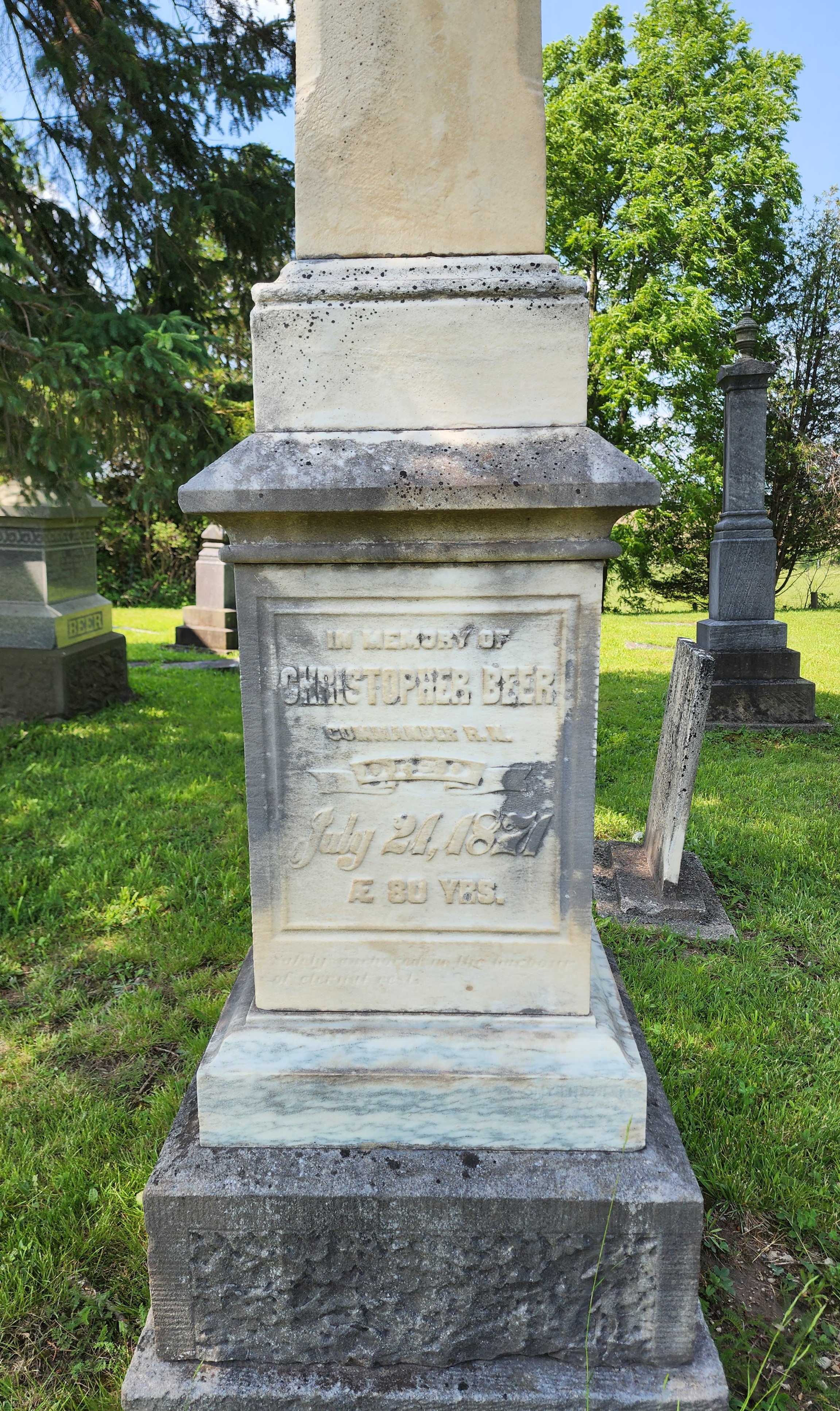
A cemetery surrounds the church. When Captain Christopher Beer died in 1871 at the age of 80, he was buried under a stone that reads "Anchored in the harbour of eternal rest." What more fitting tribute to a sea captain?

The grave of Captain Christopher Beer at St. Mary's, Napier.

In another corner lie the remains of Joe and Mary Wrinkle:

The original, now nearly illegible Wrinkle grave marker, next to a newer monument.

The replacement monument was recently added by Joe and Mary's descendants.

Joe was a fugitive slave from Louisiana who followed the Underground Railway to its ultimate destination, Canada. According to Napier resident Dana Bernier, who related Joe's story at this year's Decoration Day service, Joe was offered his white bride as partial payment for work on a local farm. According to a booklet entitled Napier Remembered, Joe worked on the Beer estate, and his wife was Mary McPhail of St. Thomas. When folks asked her why she married Joe, she replied, "His gracious manners and kindly ways took my fancy. The colour of his skin doesn't matter."*** I'd like to think Mary had some choice in her marriage. 

The array of signs at St. Mary's: the blue plaque unveiled by a descendant of Christopher Beer, a contribution from the Middlesex Historic Trail, and the 911 sign indicating 1418 Melwood Drive. 

Another early building here was a schoolhouse. The earliest school building was on the St. Mary's churchyard site, but, in 1866, a two-room school was built on Mary Street. The school building standing on Mary today, S. S. No. 3 Metcalfe, was built in 1900, the different brick colours suggesting it was built partially from the bricks of the earlier school. For a while, this building was a Women's Institute. By the way, according to this, the township would like someone to buy it. 

Metcalfe S. S. No. 3 is now boarded up. Note the Middlesex Heritage Trail sign on the entranceway.


Eventually, a bustling village developed here on the banks of the Sydenham. Johnston built a store and gristmill in 1838, importing millstones from Scotland that had to be hauled here by oxen from Port Stanley. Johnston also built a sawmill to harvest the black walnut trees in the neighbourhood. Not surprisingly, an early name for the community was Johnston's Mills. Later, it was known as Puffing Town from the sound of the steam engine at one of Johnston's mills. Apparently, it was one of the earliest, if not the earliest, steam engines in western Ontario. 

Later, after the Township of Metcalfe was created in 1840, the village was named Metcalfe. It was not until a post office opened here on November 6, 1851, that the village was named Napier. Where does the name originate? Well, it might have been named after Sir Charles Napier (1782-1853), British general during the Napoleonic Wars, or his brother William (1785-1860), another general, who wrote History of the War in the Peninsula. Perhaps some of the military men at Napier served under one or the other? 

In 1857, J. G. Sutherland moved to Napier, acquired the mills from Johnston, and built a new woollen mill. His enterprises dominated the community for many years. In fact, it was Sutherland who built the store known as the Napier House in 1872.

Napier House store is in poor condition as of spring 2026. 

Eventually, the Napier post office moved into the building above. Sutherland's son-in-law, W. S. Calvert, took over the store afterwards. Calvert eventually became a federal Member of Parliament

At its height in the 1860s, Napier's population may have been about 250. The community had merchants, inns, saloons, blacksmiths, and mills. This "capital" of Metcalfe Township had a map of its own in The Illustrated Historical Atlas of the County of Middlesex (1878):


So many streets and lots laid out! But whether all the lots were occupied is a matter of conjecture at this point. Most of the streets have reverted to bush. 

There were other churches here besides St. Mary's. A frame Methodist church was built on Clover Street in about 1860, but both the church and Clover Street are gone. A Presbyterian church was built in the south end of the village about 1864, but was replaced by another in 1887. The latter, St. Andrew's, still stands, but it appears to have closed.


When an organ was installed in the church above, staunch Presbyterians were horrified. One older man, who often slept through sermons, said he never had the same feeling of sanctity while sleeping in church after the organ was added. Another fellow claimed that "it would not be long before the devil would have a fiddle in there too." Sure enough, years later, a fiddle accompanied the choir.**** 

What happened to Napier? How did such a bustling community become the backwater of today? It's mainly the fault of the railroads. Both branches of the Great Western Railway (later the Grand Trunk and still later the CNR) bypassed Napier. The northern branch passed through Kerwood and the southern through Glencoe. Next, the CPR and the Michigan Central skipped the village. The people of Napier (what were they called ... Napierites?) expected to build a station on a hill south of the Napier House, but there was never any need. Much business was lost over the years as settlers moved to points along the railway. 

It's also been suggested that once the walnut trees were depleted, there was less work for the sawmills. But whatever the reason for Napier's decline, it didn't "go bust" overnight. Instead, it slowly faded during the late nineteenth and early twentieth centuries. The post office closed in 1915, and the village became part of R. R. 3, Strathroy. 

What else remains at Napier? Well, there's the Masonic Lodge next to St. Andrew's, a 1950s building replacing an earlier version declared unsafe:


Photograph and caption taken from the Middlesex Historic Trail sign at the Masonic Lodge.

This millstone from Sutherland's gristmill sits in front of the Masonic Lodge.

Today, there are numerous newer homes in the hamlet. I can't blame people for wanting to live in such a peaceful spot. Can a ghost town still be called a ghost town when it's grown in recent years? I think so. Napier is nothing like its 1800s heyday. 

On my last trip to Napier, I visited Dana and Nancy Bernier's unofficial Napier museum and archives in their garage. The collection could be archaeological (pottery, bottles, and other artifacts) as well as historical and archival (photographs of the Wrinkle family, news articles, etc.). Dana and Nancy also moved a local pioneer log cabin to their yard and restored it:

A pioneer cabin, rescued by Dana Bernier from a nearby baseball field where it was used as a concession stand.

*"Scorched Lodge Goat Mystery To Masons of Township of Metcalfe," London Free Press, January 30, 1932, p. 8.

** Napier Grist, Woolen Mills Aided Growth of Community," London Free Press, May 21, 1949, p. 31.

***Ruth Merrick, Napier Remembered: Memories of Metcalfe Township's Pioneer Community. Arva: The Medway Valley News, 1991. A quick look at ancestry.ca indicates that Joseph H. Wrinkle (1829-92) married Mary Sarah McPhail (1843-86) who came from St. Thomas. 

**** "Scorched," LFP, p. 8.

Monday, June 29, 2026

Dear Old Crathie, Adelaide's Boast


This crumbling cement-block hall at Highway 81 (Centre Road) and Crathie Drive, near Strathroy, was built in 1923 and, according to the sign at the top, was called Crathie Community Hall. 

A little building like this might be used by surrounding farmers for ... well, anything really. Bridge nights, bridal showers, debates, dances - you name it. In fact, the Middlesex Heritage Trail sign out front states that the young Guy Lombardo played here in the 1920s while still a college student. I admit that sometimes it seems like G.L. played everywhere ... but that claim to fame alone should make this building worthy of preservation. 

The sign also records the words to a song children were expected to sing at Literary Society meetings. held inside. I've reproduced some of the lyrics below. 

Crathie on the Hill

Of all the places far and near

There's none that can compare

With dear old Crathie, Adelaide's boast

Your're lucky if you're here.

Chorus

Crathie, Crathie that's the place for me

There's everything there from A to Z

Real good roads and shady trees

For work and comfort the people all use skill

So let's offer a toast to Adelaide's boast

Dear old Crathie on the hill.

A few explanatory notes: the hall sits on a slight rise or hill; it's in the former Adelaide Township (now Adelaide-Metcalfe); and "me" rhymes with "Z" (American-style). According to the plaque, these words were sung to a tune usually associated with London. I assume that means our London. Whoever researched this sign found the song in the London Free Press on March 17, 1925.

There was more to Crathie in the old days than this hall. A post office by the same name opened in 1874 on the southwest corner of this intersection with James Anderson as postmaster. It was probably named after the village of Crathie in Scotland, about a kilometre east of Balmoral. I believe it's pronounced CRATH-ee. The post office closed in 1880, reopened in 1887, and closed for good in 1913. The area also had a blacksmith and sawmill. At one time a school stood on the northwest corner, but it was torn down in the late 1960s.* Many earlier buildings have been replaced with newer ones on the same site. For example, there's a newish home on the site of the former schoolhouse.

Century-old buildings like this one are a reminder of our rural past. Pity someone can't restore this surplus structure into a working community centre again. Once more there could be a "Dear old Crathie on the hill..."

See Jennifer Grainger, Vanished Villages of Middlesex. Toronto: Natural Heritage, 2003, pp. 6-7.

Thursday, June 26, 2025

St. Mary's Napier, Oldest Church in Middlesex

Normally, if you want to see the pioneer buildings constructed by our ancestors, you have to visit a museum like Fanshawe Pioneer Village. That's because most of our early buildings were torn down and replaced with larger, grander ones as soon as it was practical to do so. If not demolished, the earliest buildings were usually modernized to include electricity, plumbing, openable windows, and insulation. Nobody likes privations. 

That's why it's fascinating to enter one of those rare pioneer structures that's almost completely unchanged. I'm talking about St. Mary's, Napier.

St. Mary's Anglican Church, Napier, southwest of Strathroy in the Township of Adelaide-Metcalfe, held its Annual Decoration Day service on Sunday, June 22, 2025. Fred Cahill, who lives down the road, rode his horse, Beauty, to the event. She was a reminder of those long-ago days when most of the congregation arrived by horse and buggy. 

This unassuming little frame building was built in about 1841 in the village of Napier in what was, in those days, Metcalfe Township.  Centre of a thriving community founded by retired veterans of the British Army and Navy, the church remained open for weekly services until about 1920.  Then, with a dwindling congregation, the church closed. Instead of being demolished, though, it became a Chapel of Ease, still used for occasional services like the one I attended with about 30 other people (and Beauty, the horse) last Sunday.

No, my ancestors didn't live nearby, they didn't worship here, and I don't have relatives buried in the adjoining graveyard. So why attend? Because St. Mary's is now the oldest remaining church in Middlesex County and a treat for history buffs.


The story inside the service booklet states that early settler Captain Christopher Beer (gravemarker at right) was about to build himself a new house out of the local black walnut. But when he heard a church was to be constructed, he put off the building of his own home and donated the lumber to the church project instead. The walnut was used to build the chancel, pulpit, pews, and wainscotting. It's still in there today, dark and handsome as ever. 

There was more to the building project than Captain Beer, of course. The land for the church and cemetery was donated by Lieutenant Charles Preston. The Phillips family donated the oak stringers and some bricks came from Captain Johnson's brickyard. That was how a pioneer community worked; everyone pitched in what they had, whether it was time, labour, materials, or funding. 

At one time, services were so popular that a gallery was installed to accommodate everyone. But by 1895, the  gallery was deemed unsafe and the congregation was too small by then to warrant it anyway. It was removed. 

Let's step inside and see what it's like today:

"Box pews" with doors, designed to provide warmth and privacy. Such doors were common before churches were heated, allowing seating areas to retain warmth, either from bodies sitting close together or from foot warmers. When pews were owned or rented, such doors helped ensure that everyone sat in the correct place. 


Fresh flowers for the Decoration Day service. Note the walnut pulpit.

Storage.

View from the pulpit.

Pump organ added in the 1900s has not worked for 20 years. (I heard a rumour about mice.)

Close-up of the foot pedals reading "Doherty Organ." For a history of Doherty, see here.

I wonder who was small enough to sit on the back row pews? Were Victorian bums this much smaller than ours? Or did children sit here? 

Photos and documents hang on the wall. Here's a photo of those in attendance on June 30, 1963 when the blue plaque from the Archaeological and Historic Sites Board of Ontario was placed out front. One of the gents is a great-grandson of Captain Beer. 

By the way, while sitting through the half hour service presided over by Rev. Patty Dobbs Luxton of Strathroy, I became aware of the extent to which our pioneer ancestors were at the mercy of the elements. It was over 30 degrees on Sunday and this little building has only one door, early unopenable windows, and no electricity. So no air conditioning and not even a cross breeze. The heat you can't imagine. Every time I stood up, my dress stuck to the rear of the pew. Just imagine sitting there in long sleeves, multiple petticoats and a bonnet. Egad. 

Next, think about winter. No electric heat. No insulation of the modern variety. (Could there be horse hair in those walls?) No storm windows. And I'm not sure if there was ever a wood stove. The congregation might have seen the officiant's breath in the air. Huddle with your neighbours to keep warm. 

Back outside, I trotted around the graveyard. Since I first visited St. Mary's back in the 1990s, the stones have greatly deteriorated. Aside from the monument to Captain Beer (now "Anchored in the harbour of eternal rest") the others are mainly illegible:


Some TLC is obviously needed. But I'm sure that diocese funds are woefully inadequate. What's required is a fundraising organization. Would someone like to start "The Friends of St. Mary's, Napier?" I'll join.

You may be wondering why this little church closed. That's easy. It's in a ghost town. Napier, on the Sydenham River, was once one of the most important villages in west Middlesex. It was a milling village, built to take advantage of the walnut trees in the vicinity. Once the walnut trees were depleted, there was obviously less work for the sawmills.

But in 1857, according to Lovell's Canada Directory, Napier also had a gristmill, woollen mill, school, store, blacksmith, shoemaker, waggon maker, saloon, and many homes. By 1864, there were two hotels, the Napier Inn and the Sydenham House, and a population of about 250. A post office named Napier opened on November 6, 1851, under postmaster James Keefer, who was running a store with Captain John Arthur. Mail came by stagecoach. 

In all probability, Napier faded after being bypassed by the railroads. Both branches of the Great Western Railway, later the Grand Trunk or CNR, were built elsewhere, the north branch through Kerwood and the southern through Glencoe. Later the village was bypassed by the CPR and the Michigan Central. The community just couldn't win. The post office closed in 1915. 

Recently there was an attempt to restore one of Napier's old buildings, the 1872 Napier House store. The effort failed and it now looks like this: 


Apparently a saviour is needed here too. 

A greater puzzle, as far as I'm concerned, is why St. Marys was preserved after closing. In 1939, it was in poor repair, turrets fallen off the tower, windows broken, and the graveyard thick with weeds. It was restored, when and by whom I'm not sure. But with no regular congregation, there was no need for updates. It seems that enough people cared about St. Mary's to preserve it, even if it remained a primitive pioneer structure.  

I hope it remains for many years to come.